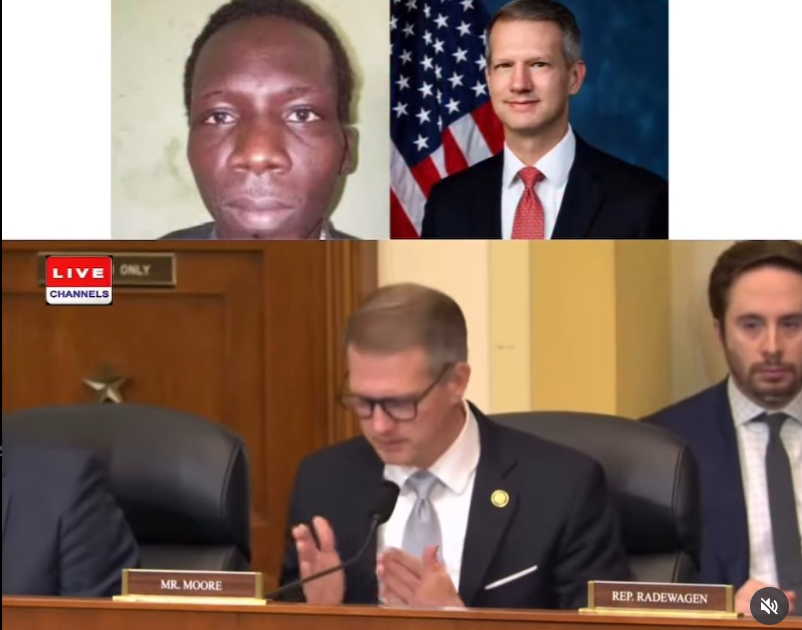
US Congressman Riley Moore has called on the Nigerian government to pardon Sunday Jackson, a farmer from Adamawa State who is currently on death row after being convicted of killing a Fulani herdsman in what he claims was an act of self-defence.
During a hearing in the U.S. House of Representatives on President Donald Trump’s redesignation of Nigeria as a Country of Particular Concern (CPC), Moore argued that Jackson’s conviction was unjust. He explained that Jackson had been attacked by armed herdsmen while working on his farm and fought back to save his life. In the struggle, one of the herdsmen was killed, leading to Jackson’s arrest and eventual death sentence by an Adamawa State High Court.
Moore told lawmakers: “I would urge the Nigerian government to take a look at pardoning Sunday Jackson, who is an individual who was fighting for his own life, defending his life against one of these Fulani militants. That Fulani militant lost his life in that struggle, and now that person, Sunday Jackson, is facing the death penalty. Where is the justice in that?”
The case has reignited debate about Nigeria’s justice system and the wider issue of farmer–herder violence in the Middle Belt. Rights groups and observers argue that Jackson’s situation reflects the vulnerability of rural farmers who often face violent clashes with armed herders. Critics say the conviction highlights systemic failures in protecting victims of such attacks, while others insist that the rule of law must be upheld regardless of circumstances.
Moore’s intervention has drawn international attention to the case, adding pressure on Nigerian authorities to reconsider Jackson’s sentence. His appeal also underscores growing foreign scrutiny of Nigeria’s handling of human rights and security challenges, particularly in regions plagued by communal violence.
For many Nigerians, the case is emblematic of the broader crisis of insecurity and the struggle for justice in rural communities. Whether Jackson receives a pardon or not, his story has become a focal point in discussions about fairness, self-defence, and the responsibilities of the state in safeguarding its citizens.
Leave a Reply